
Introduction
In today’s hyper-connected world, having fast and reliable internet is no longer a luxury—it’s a necessity. From streaming ultra-HD content to managing smart homes and running businesses, wireless technology plays a crucial role. The introduction of WiFi 6 (802.11ax) brought a major leap in speed, efficiency, and device handling. Now, the next generation, WiFi 7 (802.11be), is pushing boundaries even further.
This article provides a complete, SEO-friendly, and in-depth comparison between WiFi 6 vs WiFi 7, covering features, performance, speed, real-world usage, and future impact.
What is WiFi 6? (802.11ax)
WiFi 6 is the sixth generation of wireless networking technology introduced to solve problems like congestion, slow speeds, and poor performance in crowded environments.
Key Features of WiFi 6
- Maximum Speed: Up to 9.6 Gbps
- OFDMA (Orthogonal Frequency Division Multiple Access)
- MU-MIMO (Multi-User Multiple Input Multiple Output)
- Target Wake Time (TWT)
- Improved battery life for devices
- Works on both 2.4GHz and 5GHz bands
Benefits of WiFi 6
✔ Better performance in crowded areas
✔ Lower latency
✔ Improved efficiency for multiple devices
✔ Enhanced security with WPA3 encryption
WiFi 6 is ideal for homes with many connected devices like smartphones, laptops, smart TVs, and IoT devices.
What is WiFi 7? (802.11be)
WiFi 7 is the latest wireless standard designed for ultra-high speed, extremely low latency, and next-level performance. It is also called Extremely High Throughput (EHT).
Key Features of WiFi 7
- Maximum Speed: Up to 46 Gbps
- Supports 320 MHz channel bandwidth
- Multi-Link Operation (MLO)
- Uses 4096-QAM (4K-QAM)
- Operates on 2.4GHz, 5GHz, and 6GHz bands
- Ultra-low latency for real-time applications
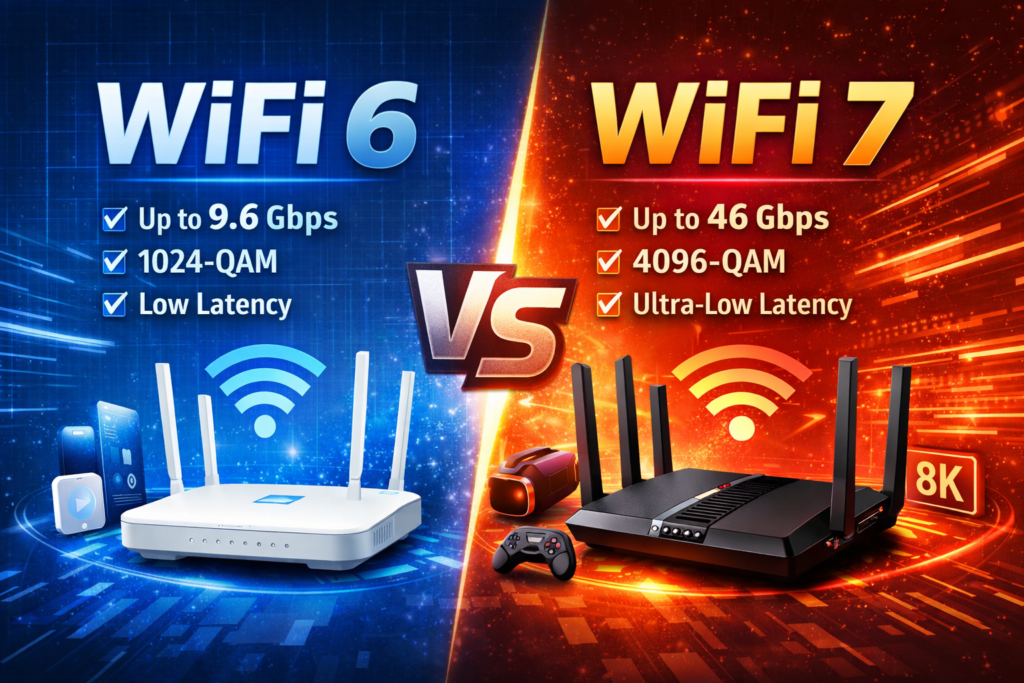
WiFi 6 vs WiFi 7: Side-by-Side Comparison
| Feature | WiFi 6 (802.11ax) | WiFi 7 (802.11be) |
|---|---|---|
| Max Speed | 9.6 Gbps | 46 Gbps |
| Frequency Bands | 2.4GHz, 5GHz | 2.4GHz, 5GHz, 6GHz |
| Channel Width | 160 MHz | 320 MHz |
| Modulation | 1024-QAM | 4096-QAM |
| Latency | Low | Ultra-Low |
| Multi-Link Operation | ❌ | ✔ Yes |
| Device Efficiency | High | Very High |
| Best Use Case | Homes, offices | Gaming, AR/VR, future tech |
Key Technology Differences Explained
1. Speed and Performance
The biggest difference is speed.
- WiFi 6 offers up to 9.6 Gbps
- WiFi 7 can reach up to 46 Gbps
This means WiFi 7 is almost 5 times faster than WiFi 6.
Real-World Impact
- 4K/8K streaming becomes smoother
- Instant downloads of large files
- Lag-free gaming experience
2. Channel Bandwidth
- WiFi 6: 160 MHz
- WiFi 7: 320 MHz (double)
Wider channels mean more data can pass at once, leading to higher speeds and better efficiency.
3. Multi-Link Operation (MLO)
One of the most powerful features of WiFi 7 is Multi-Link Operation.
What it does:
- Allows devices to connect to multiple bands simultaneously
- Improves speed and reduces latency
Example:
A device can use 5GHz + 6GHz together for faster and stable connection.
4. 4096-QAM vs 1024-QAM
WiFi 7 uses 4096-QAM, which allows more data to be packed into each signal.
- WiFi 6: 1024-QAM
- WiFi 7: 4096-QAM (4x data efficiency)
This results in higher throughput and faster data transfer.
5. Latency (Delay)
Latency is critical for gaming and real-time apps.
- WiFi 6: Low latency
- WiFi 7: Ultra-low latency
Best for:
- Cloud gaming
- Video conferencing
- AR/VR applications
6. Frequency Bands
WiFi 7 introduces full use of the 6GHz band.
Advantages of 6GHz:
- Less interference
- More channels
- Higher speed
Real-Life Use Cases
WiFi 6 is Best For:
- Homes with many devices
- Office environments
- HD streaming
- Online meetings
WiFi 7 is Best For:
- 8K streaming
- Cloud gaming
- Virtual Reality (VR) & Augmented Reality (AR)
- Smart cities and automation
- Future-proof networking
Gaming Performance: WiFi 6 vs WiFi 7
Gamers benefit hugely from WiFi 7.
WiFi 6
- Good for casual gaming
- Stable performance
WiFi 7
- Ultra-low ping
- No lag spikes
- Seamless multiplayer gaming
Device Compatibility
WiFi 6 Devices
- Smartphones
- Laptops
- Routers
- Smart TVs
WiFi 7 Devices
Currently limited but growing fast:
- Latest flagship smartphones
- Advanced routers
- Gaming devices
Power Efficiency
WiFi 6 introduced Target Wake Time (TWT), which helps devices save battery.
WiFi 7 improves this further with:
- Faster data transfer
- Reduced active time
Security Improvements
Both standards support WPA3 encryption, ensuring:
✔ Stronger password protection
✔ Enhanced privacy
✔ Protection against cyber attacks
Advantages of WiFi 6
✔ Affordable and widely available
✔ Great for current needs
✔ Stable performance
✔ Compatible with most devices
Advantages of WiFi 7
✔ Extremely high speed
✔ Future-proof technology
✔ Ultra-low latency
✔ Better for heavy applications
Disadvantages of WiFi 6
❌ Slower compared to WiFi 7
❌ Limited future scalability
Disadvantages of WiFi 7
❌ Expensive (currently)
❌ Limited device support
❌ Requires new hardware
Should You Upgrade to WiFi 7?
Upgrade if:
✔ You are a gamer
✔ You use AR/VR
✔ You want future-proof internet
✔ You have high-speed internet (1Gbps+)
Stay with WiFi 6 if:
✔ Your usage is normal (browsing, streaming)
✔ Budget is limited
✔ Your devices don’t support WiFi 7
Future of WiFi Technology
WiFi 7 is designed for the future:
- Smart homes
- AI-powered devices
- Autonomous systems
- 8K/16K streaming
It will become the new standard in coming years.
Conclusion
The comparison of WiFi 6 vs WiFi 7 clearly shows that while WiFi 6 is still powerful and sufficient for most users, WiFi 7 is a game-changer.
- If you want reliable, cost-effective performance, go with WiFi 6
- If you want maximum speed, ultra-low latency, and future-ready technology, choose WiFi 7
In simple words:
👉 WiFi 6 = Present Needs
👉 WiFi 7 = Future Technology
